
Root of all evil
Distortion
1. An undesired change in the waveform of a signal.
2. A consequence of such a change, especially a lack of fidelity in reception or reproduction.
In practice, all electrical systems will produce some degree of distortion. The art of design is to see that such distortion is maintained within acceptable bounds, while the signal is otherwise modified in the desired fashion.
In the sense of high fidelity this mean that any distortion is (theoretically) unacceptable
All level distortion can be sub-characterised as either Linear or Non-Linear distortion.
Linear distortion is an amplitude distortion in which the output signal envelope is not proportional to the input signal envelope
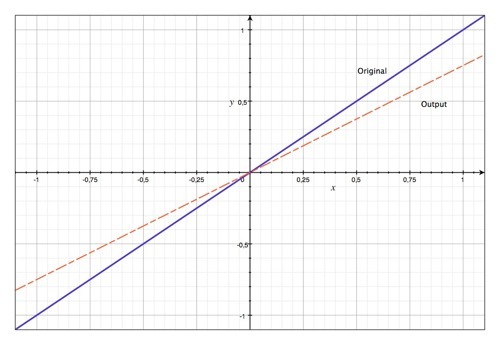
The picture above show an example of linear distortion. A simple amplitude distortion where the output signal is lowered compared with the original.
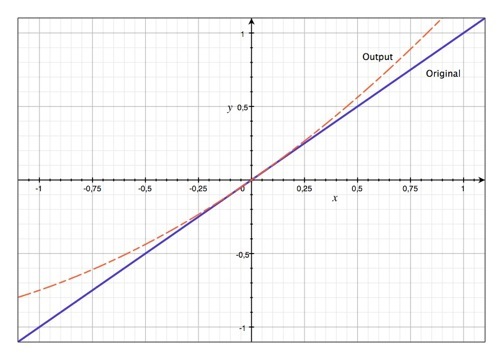
The picture above show an example of non-linear distortion where the output signal is changed by the amplitude of the input signal. There is a non linear relationship between the input and the output, hense Non-linear distortion.
Linear distortion is very easily heard in A-B tests, but on the other hand also fairly simple to correct. In the case of amplitude distortion showed above simply turn up the volume!
More complex is the non-linear distortion. It is harder to hear in A-B test because the energy of the signal is kept but the timbre of the signal is changed. The non-linearity is producing harmonic distortion and intermodulation products, which once they are added to the signal are almost impossible to remove again. The key word is MODULATION, any 2 (or more) tones will when passing thought a non-linear circuit create 2 new tones in the signal. More about this in non-linear distortion section
EVERY(analogue) link of an audio chain produces a non-linear distortion, and will by nature degrade the signal.
In the category of linear distortion we have :
Amplitude distortion
Frequency distortion
Phase distortion
Delay
In the category of non-linear distortion we have :
Cross modulation
Aliasing
Compression
Jitter
More about Distortion
Ringing - or resonant
Furthermore there are distortion phenomena which is based on the fact the circuit have a tendency to oscillate. All speakers, filters, rooms, will at certain frequencies resonate and thereby extend the signal at that given frequency in time, or worse play the frequency without having the frequency represented in the original signal.
This kind of distortion is not that represented in the literature or public debate, which is a shame, because in my believe a lot of a devices eigen-sound is produced by this phenomena.
The major difference between sample-frequencies, except from audio-range, is the pre & post ringing of the filters in the converters.
The last couple of years there has been some debate about Room correction and some advanced digital machines has been build & sold as very exclusive products.
Room Correction has lately turned into a buss word in audio, but in my opinion is kind of overrated for several reasons:
-
1) Reasons in rooms are heard differently, depending on your position.
-
2) Reasons in rooms in the critical audio area (600-10 kHz) are fairly easy in your living room dimmed by furniture and carpets etc.
-
3)The reasons are happening in a 3D space - and therefore easier for our ears to differentiate from the music. Opposite when the resonant are created in the speakers or in the audio chain, here the resonant are embedded into the music and a lot harder for our ears to neglect.
-
4)Reasons in the room does not degrade the actual sound coming from your speakers. Any circuit inserted in the audio chain to compensate for the room will the
-
5)The room is the last stage of the audio chain. Generally most attention should be pay to the first stage, due to the intermodulation phenomena
When all this is said, a nice sounding room is good, but the amount of effort to create the “perfect” room should be taking into consideration. Maybe your money and time is better spend on other issues.
More about Ringing